Why Bleach Does Not Fix Mold Problems (And What Actually Works)
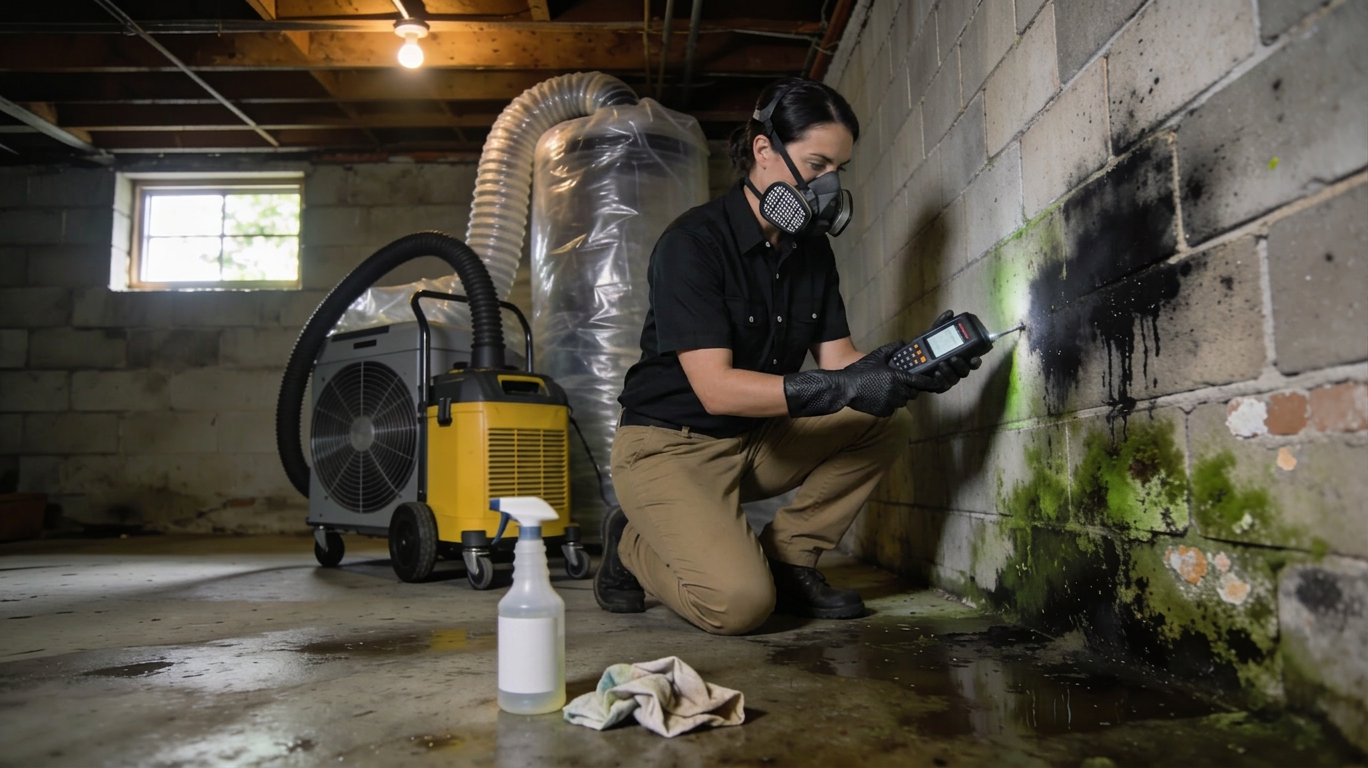
Bleach is one of the most common first responses when Michigan homeowners or property managers spot mold in a basement, bathroom, or on a wall after water damage. It seems logical: bleach kills bacteria, it disinfects surfaces, and it visibly removes the dark staining that mold leaves behind. The problem is that what looks like a fix is often just a temporary cosmetic change. Bleach does not reach the root of the mold problem—literally—and in many situations it can make conditions worse by adding moisture to already damp materials. EPA's mold guidance specifically moved away from recommending bleach for mold cleanup on porous surfaces for exactly these reasons.
https://www.epa.gov/mold/mold-cleanup-your-home
For homeowners, landlords, property managers, and investors across Metro Detroit, Warren, and other Michigan communities, this distinction matters practically and financially. Mold that is wiped down with bleach and appears to be gone can continue growing beneath the surface and return within days or weeks. If the moisture source that created it is never addressed, no surface treatment will solve the problem—it will simply keep coming back. Understanding why bleach fails and what a proper mold remediation process actually involves can save you from repeated repairs, growing damage, and the health risks that come with ongoing mold exposure.
Why Bleach Does Not Work on Mold
Bleach Cannot Penetrate Porous Materials
The core reason bleach fails on mold is straightforward: mold does not just sit on top of a surface. When mold grows on porous materials like drywall, wood framing, ceiling tiles, or grout, it sends root-like structures called hyphae into the material itself. Bleach, which is a water-based solution, cannot penetrate far enough into porous materials to reach and kill those embedded structures.
The water content in bleach can actually be counterproductive. When you apply bleach to a porous surface, the chlorine evaporates or stays near the surface while the water soaks deeper into the material, where mold roots are growing. You may be inadvertently adding moisture to the very substrate where mold is already established.
EPA's mold cleanup guidance reflects this understanding, noting that porous materials with heavy mold contamination typically need to be removed and replaced rather than cleaned in place. The idea that bleach is an effective mold remediation tool on porous surfaces is not supported by how professional mold remediation is actually done.
https://www.epa.gov/mold/mold-cleanup-your-home
It Addresses the Symptom, Not the Source
Even on non-porous surfaces where bleach can be more effective at killing surface mold, it does nothing about the moisture conditions that allowed mold to grow in the first place. CDC's mold health overview is clear that mold growth is a sign of an underlying moisture problem, and that cleaning up mold without correcting the source of moisture will result in mold growing back.
https://www.cdc.gov/mold-health/about/index.html
Basement mold after water damage, mold after flooding, and chronic mold smell in house areas almost always have a moisture driver: a seeping foundation, inadequate drainage, a plumbing leak, a condensation problem, or poor ventilation. Treating the visible mold without repairing the moisture source is exactly like mopping a floor while the faucet is still running.
Why Mold Keeps Coming Back After Bleach Treatment
If you have used bleach on mold and seen it return within weeks or months, this is why. The mold colony is not eliminated below the surface, and if moisture conditions remain favorable, regrowth is almost inevitable. In some cases, mold treated with bleach may even become more difficult to detect because the staining is temporarily removed while active colonies continue below the surface.
NIEHS notes that indoor dampness and mold are consistently associated with respiratory symptoms, asthma, and other health effects regardless of the specific mold species involved.
https://www.niehs.nih.gov/health/topics/agents/mold
For landlords and property managers, this has practical consequences. Mold that keeps returning after surface treatment is not a cleaning problem—it is a building problem that requires mold remediation, not mold cosmetics.
What Mold Actually Needs to Survive
Understanding why bleach fails also means understanding what mold needs to thrive. Mold requires three things:
Moisture – The single most controllable factor. Remove moisture and mold cannot grow.
A food source – Organic materials like drywall paper, wood studs, ceiling tiles, and carpet backing all feed mold.
Time – Given moisture and food, mold can begin establishing colonies within 24 to 48 hours after a water event.
This is why water damage mold risk is so high in basements, crawlspaces, and areas around plumbing—these are places where moisture and organic building materials consistently intersect. It is also why mold in commercial buildings tends to cluster around flat roofs, poorly drained HVAC drain pans, and areas that have experienced repeated leaks without complete drying.
Effective mold remediation targets all three of these factors, not just the visible mold growth.
What Actually Works: A Proper Mold Remediation Process
Step One: Find and Fix the Moisture Source
Before any mold removal begins, the moisture source must be identified and corrected. This might involve:
Repairing roof or window leaks that have allowed water to enter wall cavities or attic spaces
Addressing foundation seepage or inadequate basement waterproofing
Fixing plumbing leaks behind walls, under sinks, or around water heaters
Improving ventilation in bathrooms, laundry areas, and crawlspaces
Correcting grading or drainage issues that direct surface water toward the foundation
Skipping this step guarantees that mold will return after remediation, no matter how thoroughly the mold removal is performed.
Step Two: Contain the Affected Area
Professional mold remediation uses containment to prevent mold spores from spreading to unaffected parts of the building during the removal process. This typically involves:
Sealing off the work area with polyethylene sheeting
Closing and blocking HVAC registers to prevent spore distribution through the duct system
Using negative air pressure within the work area so air flows in rather than out
Establishing a decontamination area where workers remove personal protective equipment before leaving the contained zone
Without containment, the process of disturbing mold-contaminated materials can spread spores throughout the building and create new mold conditions in previously unaffected areas. This is one of the key reasons why professional mold remediation produces fundamentally different outcomes than surface scrubbing with bleach.
Step Three: Remove Contaminated Materials
Porous materials with significant mold contamination are removed and disposed of rather than cleaned in place. EPA's guidance on mold cleanup explains that porous materials like drywall, insulation, and ceiling tiles that are heavily contaminated with mold should typically be bagged and removed rather than treated in place, because surface cleaning cannot eliminate embedded mold growth.
https://www.epa.gov/mold/mold-cleanup-your-home
Materials commonly removed during mold remediation include:
Mold-contaminated drywall and drywall paper
Insulation in affected wall cavities, attic spaces, or crawlspaces
Carpet and carpet padding with significant mold growth
Ceiling tiles and drop ceiling components
Wood framing or sheathing with deep mold penetration
Non-porous surfaces in the work area can be cleaned using appropriate cleaning agents and HEPA vacuuming, but the standard for porous material is removal.
Step Four: HEPA Vacuum and Clean
After contaminated materials are removed, remaining surfaces in the work area are cleaned using HEPA vacuums and appropriate cleaning products. HEPA filtration is critical because standard vacuums release captured particles back into the air, while HEPA filters trap particles as small as mold spores. Air scrubbers with HEPA filtration are also commonly run in the work area during and after removal to capture airborne spores.
This level of cleaning is why professional mold remediation is not comparable to a DIY cleaning session. The equipment, containment, and material disposal practices are fundamentally different from what a homeowner can accomplish with household cleaning products.
Step Five: Dry and Verify
After mold removal and cleaning, the affected area must be dried completely before reconstruction begins. Moisture readings in building materials should be verified with calibrated meters to confirm that conditions are no longer favorable for mold growth.
CDC and NIOSH both note that post-remediation verification is an important part of confirming that work was effective, and that returning moisture or inadequate drying can lead to re-contamination.
https://www.cdc.gov/niosh/mold/testing-remediation/index.html
For larger or more complex projects, post-remediation testing may include air sampling or surface sampling to confirm that spore levels in the remediated area are comparable to or better than baseline outdoor levels.
Mold Health Risks: Why Getting This Right Matters
Mold exposure is not just an aesthetic or property condition problem. CDC notes that exposure to mold can cause nasal stuffiness, throat irritation, coughing or wheezing, eye irritation, and skin irritation. For people with asthma or respiratory conditions, mold exposure can trigger more severe reactions.
https://www.cdc.gov/mold-health/about/index.html
Black mold symptoms—a term often used to describe reactions to Stachybotrys chartarum—can include chronic coughing, fatigue, and upper respiratory irritation. However, health professionals emphasize that any mold species in high concentrations can be problematic, and the appearance or color of mold is not a reliable indicator of its health significance.
For Michigan rental owners and mold remediation for landlords managing occupied properties, these health risks create real exposure to tenant complaints, liability, and regulatory action. Addressing mold with bleach and calling it done is not a defensible response when a tenant or building occupant reports health symptoms tied to mold conditions.
When DIY Crosses the Line into Professional Territory
EPA provides guidance for small-scale mold cleanup involving limited areas, generally suggesting professional help is warranted when the affected area exceeds 10 square feet or when mold is in the HVAC system, is associated with sewage or contaminated water, or when occupants have health conditions that make exposure a concern.
For Michigan property owners and investors, the practical threshold for calling in professional mold remediation is often lower:
Any mold in commercial buildings or multi-unit residential properties where multiple occupants may be affected
Mold after flooding or significant water events where the full extent of contamination is unknown
Recurring mold that has returned after previous cleaning attempts
Mold smell in house areas where no visible growth can be located, suggesting hidden contamination
Any situation where contaminated materials need to be removed and the moisture source is structural
Professional mold inspection is the right starting point when you are not sure of the scope. A mold inspection can document where contamination exists, how far it extends, and what the remediation scope should be—information that is essential for accurate cost planning and for demonstrating that you responded appropriately.
Mold and Other Overlapping Hazards in Michigan Properties
In many older Michigan homes and commercial buildings, mold does not appear alone. Water events and the resulting mold damage often intersect with other hazardous materials in homes:
Asbestos-containing materials in flooring, ceiling tiles, joint compound, and insulation. Best practice is to assume suspect materials may contain asbestos regardless of construction date, because some imported drywall, flooring, and ceiling products from countries with less stringent controls can still contain asbestos today. Regardless of when your property was built, treat suspect materials as potentially asbestos-containing until asbestos inspection and asbestos testing prove otherwise.
Lead-based paint on walls and trim that may be disturbed when mold-contaminated drywall or surfaces are removed. Lead-safe work practices must be incorporated when lead-based paint may be present in homes where mold remediation involves cutting or demolishing surfaces.
Coordinating environmental remediation services—mold remediation, asbestos abatement, and lead paint removal—under one plan is the most efficient and safest approach when these hazards overlap in the same project area.
The Right Way to Handle Mold in Michigan Properties
Bleach is a cleaning product, not a mold remediation strategy. For small, non-porous surface mold in truly dry conditions, it may have a limited role. For the mold problems that actually affect Michigan homes and buildings—basement mold after water damage, mold inside walls, mold in commercial buildings after leaks or flooding—it is not a solution. Proper mold remediation means fixing the moisture source, containing the work area, removing contaminated materials, cleaning with HEPA equipment, drying completely, and verifying results.
If you are dealing with mold in a Michigan home, rental property, or commercial building—whether it is recurring growth you cannot get ahead of, mold after flooding, or a persistent mold smell you cannot locate—BDS Environmental can help. The team works with homeowners, landlords, property managers, contractors, and investors to properly scope mold problems, identify hidden moisture sources, and carry out professional mold remediation that addresses the root cause rather than just the surface appearance. If you suspect mold is more than a cleaning issue, contact BDS Environmental to discuss your situation and find out what it actually takes to solve it.