Attic Mold: Why It Happens and How to Prevent It
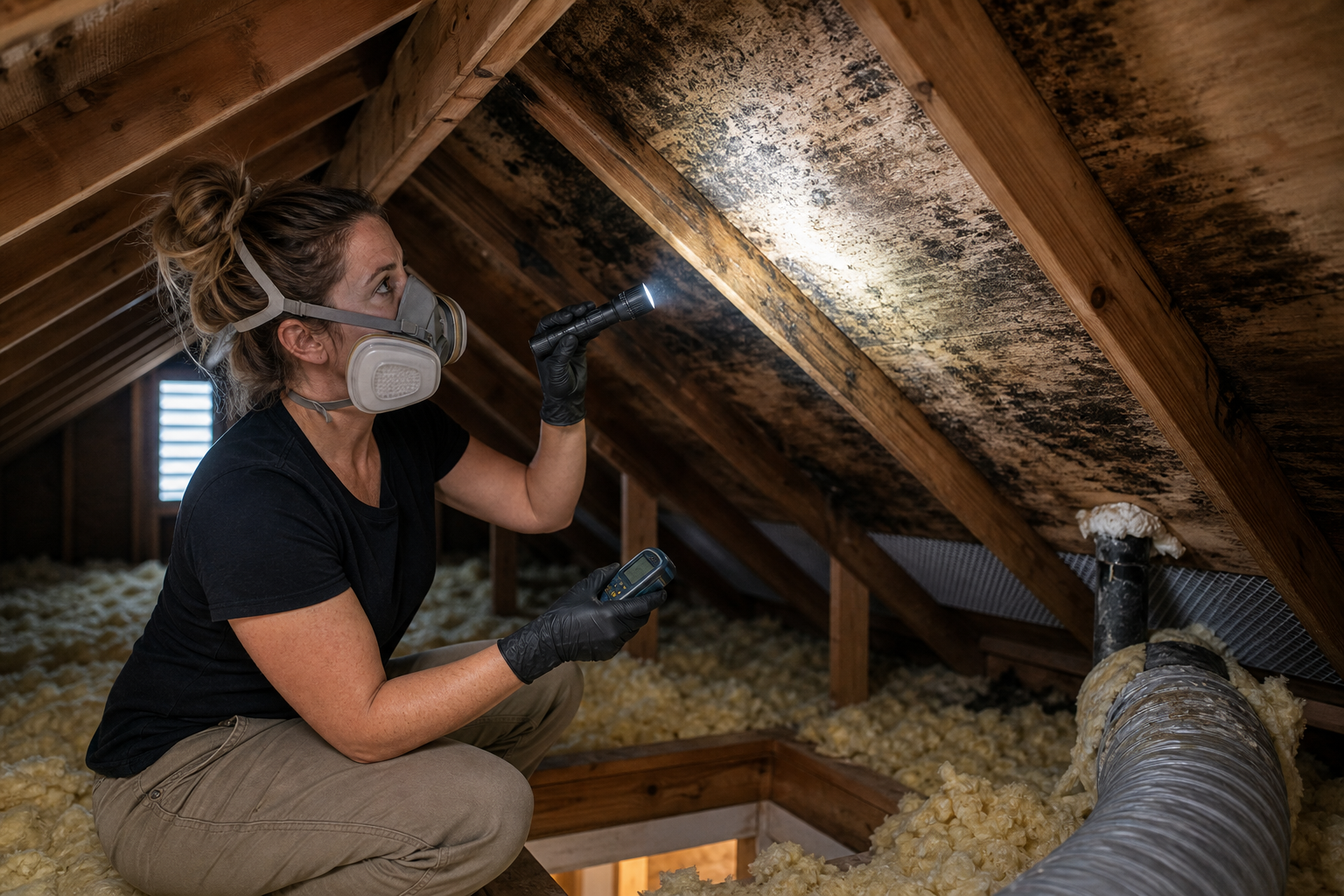
Attic mold is one of the most commonly overlooked environmental conditions in Michigan homes and residential investment properties. Most homeowners never go into their attic more than once or twice a year—if at all—which means mold can establish itself on roof sheathing, rafters, and insulation and grow unchecked for months or years before anyone notices it. By the time attic mold is discovered, it is often because a home inspector flagged it during a real estate transaction, a roofing contractor spotted it during a repair, or a homeowner finally investigated after noticing a persistent mold smell in house areas near the ceiling on the top floor. At that point, what could have been a preventable ventilation issue has become a remediation project.
For homeowners, property managers, and investors managing Michigan residential properties, attic mold is a particularly important hazard to understand because its root causes are almost always mechanical and correctable—yet they are consistently missed until significant mold growth is already present. Michigan's cold winters create the exact conditions that drive attic moisture problems: warm, humid interior air rises through ceiling bypasses and improperly sealed penetrations, contacts cold roof sheathing, and condenses. Over time, that repeated condensation cycle creates the sustained moisture that mold needs to colonize wood surfaces. Understanding why attic mold develops, where to look for it, and what it takes to properly address it protects your property, your air quality, and the structural integrity of the roof assembly above you.
Why Attics Are Especially Vulnerable to Mold
The Moisture Equation in Michigan's Climate
Mold needs three things: moisture, a food source, and time. Attics supply all three in abundance under the wrong conditions. Wood roof sheathing and framing members are an excellent food source. Michigan's cold winters create significant temperature differentials between conditioned living space below and the exterior roofline above. And when warm indoor air carrying moisture vapor migrates into the attic space, it condenses on cold surfaces and creates the sustained dampness mold needs to grow.
NIEHS notes that indoor dampness and mold are consistently associated with respiratory symptoms, asthma, and respiratory infections, underscoring why resolving the moisture conditions driving attic mold is a health issue, not just a structural one.
https://www.niehs.nih.gov/health/topics/agents/mold
Inadequate Attic Ventilation
The single most common driver of attic mold in Michigan homes is inadequate ventilation. A properly ventilated attic maintains airflow that carries moisture-laden air out before it can condense on cold sheathing surfaces. When soffit vents are blocked by insulation, when ridge vents are improperly installed, or when ventilation is simply insufficient for the volume of the attic space, moisture accumulates and mold follows.
This problem is especially common in Michigan homes where attic insulation has been added or updated over the years without corresponding attention to soffit vent clearance. Well-intentioned energy improvements can inadvertently block the intake airflow that makes the entire ventilation system work, creating a moisture trap right above the living space.
Air Leakage From Living Space Below
Even well-ventilated attics can develop mold problems when warm, humid air from the living space below bypasses the ceiling plane and enters the attic directly. Common pathways include:
Unsealed penetrations around recessed lighting fixtures
Gaps around plumbing vents, electrical chases, and HVAC ducts that pass through the ceiling
Inadequately sealed attic access hatches and pull-down stair assemblies
Bathroom and kitchen exhaust fans that terminate inside the attic rather than outside the building envelope
When bathroom or kitchen exhaust fans dump warm, humid air directly into the attic instead of venting it to the exterior, they can be a primary moisture source responsible for significant mold growth on sheathing directly above where the duct terminates.
Roof Leaks and Ice Dam Damage
Roof leaks from failed flashing, missing or damaged shingles, and deteriorated boot seals around penetrations create another moisture pathway into attic assemblies. In Michigan, ice dams are a seasonal contributor to roof-level moisture intrusion: ice accumulation at eaves forces water back under shingles and into the roof assembly, where it can wet sheathing, rafters, and insulation repeatedly through a single winter.
Mold growth following roof leaks or ice dam events may not be immediately visible during the water event itself. It develops in the days and weeks that follow if the wet materials are not dried promptly and completely. CDC's guidance on mold makes clear that mold can begin growing on wet building materials within 24 to 48 hours of a water event, which is why rapid drying after any roof-level moisture intrusion is critical.
https://www.cdc.gov/mold-health/about/index.html
What Attic Mold Looks Like and Where to Find It
Attic mold most commonly appears as dark discoloration on the underside of roof sheathing—the plywood or OSB panels directly above the rafters. It may appear as diffuse gray, green, or black staining spread across large sections of sheathing, or as more concentrated colonies in areas where moisture is highest, such as directly above exhaust fan terminations, near ridge vents that are not functioning properly, or at eave areas affected by ice dam intrusion.
Common locations to inspect in Michigan attics include:
The underside of sheathing throughout the entire attic, especially in areas with limited airflow near the eaves
Rafter and collar tie surfaces where moisture condensation collects
Insulation batt surfaces, particularly faced batts where moisture can condense on the facing
Areas directly above bathroom exhaust fans and other penetrations in the ceiling plane
The perimeter of the attic near exterior walls, where cold surfaces and limited airflow create the most condensation risk
Because attic mold often develops in areas that are not easily visible from the attic hatch, a thorough inspection requires actually moving through the attic space—not just looking in from the opening.
Health Implications of Attic Mold
How Attic Mold Affects Indoor Air Quality
A common misconception about attic mold is that it is separated from living space and therefore does not affect occupants. In reality, air moves through buildings in ways that carry attic air into living spaces. Stack effect—the tendency of warm air to rise and exit at the top of a building while drawing replacement air in from below—means that air pressure dynamics can pull attic air down through ceiling penetrations and into occupied rooms, particularly during cold Michigan winters.
This is one reason homeowners with significant attic mold sometimes report persistent mold odor or unexplained respiratory symptoms in the rooms on the top floor of the home. EPA's mold guidance notes that mold exposure can cause nasal stuffiness, throat irritation, coughing, and eye irritation, with more severe reactions in people with respiratory conditions or immune system compromise.
https://www.epa.gov/mold/mold-cleanup-your-home
When Black Mold Symptoms Prompt Investigation
Tenants and occupants who report symptoms consistent with mold exposure—chronic congestion, persistent cough, or eye irritation that improves when they leave the home—sometimes trigger attic mold investigations that reveal significant contamination that had been growing undetected for an extended period. For landlords managing older Michigan properties, an occupant complaint about indoor air quality is a signal worth taking seriously, including an attic inspection as part of the diagnostic process.
Proper Mold Remediation for Attic Conditions
Why Surface Cleaning Is Not Enough
Attic mold remediation is not a cleaning project. The same principle that applies to basement mold after water damage applies here: mold that has penetrated the surface of wood sheathing cannot be eliminated by surface scrubbing. EPA's mold guidance explains that porous materials with significant mold contamination require removal rather than cleaning in place, and that surface treatment alone does not reach embedded mold growth.
https://www.epa.gov/mold/mold-cleanup-your-home
Depending on the extent of contamination, attic mold remediation may involve:
Removal and replacement of heavily contaminated sheathing sections
HEPA vacuuming and cleaning of all contaminated structural surfaces
Treatment of remaining wood framing with appropriate antimicrobial products after cleaning
Containment of the work area to prevent spore migration into living space during remediation
Air scrubbers with HEPA filtration running throughout the remediation process
Clearance testing after attic mold remediation confirms that spore levels in the attic and in adjacent living space are within acceptable ranges before reconstruction or insulation reinstallation proceeds.
Correcting the Moisture Source First
No attic mold remediation is complete without correcting the moisture source that caused the problem. EPA is clear that mold removed without correcting underlying moisture conditions will return.
https://www.epa.gov/mold/mold-cleanup-your-home
For attic mold, moisture correction typically involves one or more of the following:
Restoring proper soffit and ridge ventilation to allow adequate airflow through the attic space
Air sealing ceiling penetrations, attic hatches, and other bypasses that allow warm interior air to enter the attic
Rerouting bathroom and kitchen exhaust fans to terminate at the exterior, not inside the attic
Repairing roof penetrations, flashing, or shingles contributing to active moisture intrusion
Addressing ice dam conditions through improved insulation levels and air sealing at the ceiling plane
Getting the moisture correction work right before or during remediation is what makes the remediation last.
Asbestos Considerations in Attic Work
When attic mold remediation or ventilation correction work involves disturbing insulation, sheathing, or other original building materials, asbestos can become a relevant concern. Best practice is to assume suspect building materials may contain asbestos regardless of when a property was built—because some imported or foreign-manufactured insulation, drywall, and ceiling materials from countries without stringent asbestos regulations can still contain asbestos today. Regardless of when your property was built, the safest approach is to treat suspect materials as potentially asbestos-containing until asbestos inspection and asbestos testing prove otherwise.
This applies specifically in attic remediation contexts to:
Old vermiculite insulation, which has a well-documented association with asbestos contamination and should be tested before any disturbance
Original blown-in or batt insulation products in properties with original building materials
Drywall and joint compound on ceiling surfaces below the attic that may be disturbed during air sealing work
Any ceiling tiles or textured surfaces that will be penetrated or removed as part of moisture correction
Because some imported products may still contain asbestos, age alone is not a reliable way to rule it out. When attic remediation involves opening up ceiling assemblies or disturbing original insulation, commissioning an asbestos inspection before that work begins is a standard precaution that protects workers and avoids unplanned regulatory complications mid-project.
Prevention: Keeping Attic Mold From Developing in the First Place
The most cost-effective attic mold strategy is prevention. Michigan homeowners and property managers can significantly reduce attic mold risk by:
Having attic ventilation evaluated by a qualified professional, particularly after insulation upgrades or reroofing projects
Ensuring all bathroom and kitchen exhaust fans are ducted to the exterior with intact, insulated flex duct
Air sealing attic penetrations, including around recessed lights, plumbing vents, and the attic hatch perimeter, during any ceiling-level work
Scheduling periodic attic inspections—particularly after significant winter weather, ice dam events, or any roof leak—to catch early moisture conditions before mold establishes
Keeping attic insulation clear of soffit baffles so intake airflow is not restricted
For rental property owners and portfolio investors, including attic inspection as part of regular property assessment cycles and commissioning a mold inspection any time roof work or water events occur is the kind of proactive management that prevents small moisture conditions from becoming significant remediation projects.
Getting Attic Mold Handled the Right Way
Attic mold is a predictable, preventable problem in Michigan homes—but when it does develop, it requires professional mold remediation that corrects the moisture source, properly removes contaminated materials, and verifies clearance before the space is closed back up. Ignoring it or treating it with surface cleaning is not a solution; it is a delay that allows the problem to grow and the structural components of your roof assembly to sustain additional damage.
If you own or manage a Michigan property and suspect attic mold may be present—whether based on a home inspection report, a roofing contractor's observation, a persistent odor, or a history of moisture issues—BDS Environmental can help. The team works with homeowners, property managers, landlords, and investors to assess attic mold conditions, scope remediation accurately, coordinate asbestos inspection when attic materials may be disturbed, and deliver professional mold remediation that addresses the root cause rather than the surface appearance. If attic mold is a concern for your property, contact BDS Environmental to get a professional assessment and find out what it takes to resolve it correctly.