Why Asbestos Testing Is Critical Before Demolition Projects
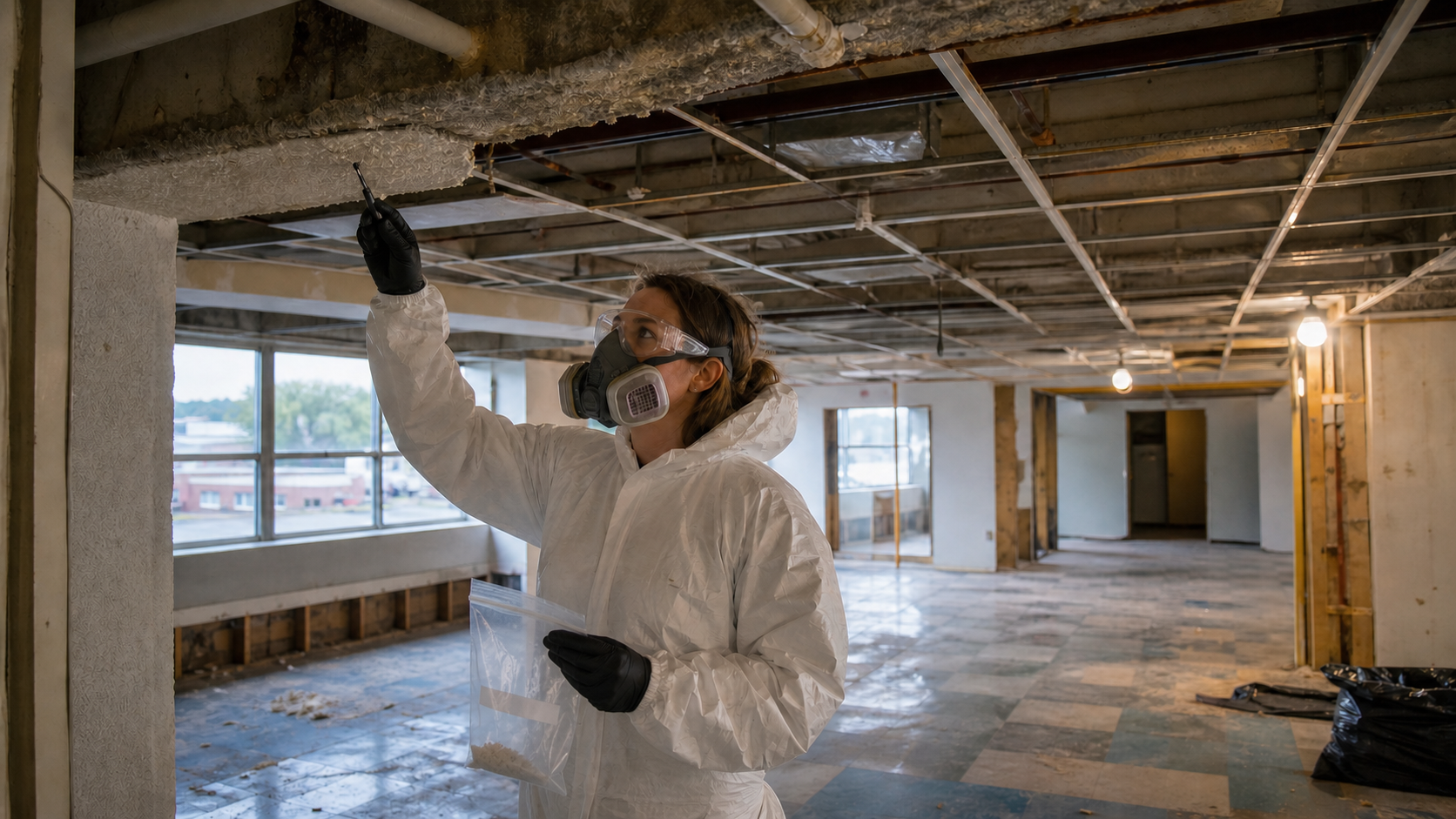
Demolition projects move on tight timelines. Whether the goal is clearing a structure for redevelopment, gutting an interior for a major renovation, or tearing down a commercial building to make way for new construction, the pressure to get demolition crews on-site and moving is real. What stops that momentum cold—and what costs far more in time, money, and regulatory exposure than the original project budget ever accounted for—is discovering asbestos-containing materials after demolition has already started. At that point, work stops, emergency containment is required, regulatory notifications go out, and a project that was days into demo is suddenly looking at weeks of delay and costs that were never in the plan. Every one of those scenarios is preventable with a single step: professional asbestos testing before demolition begins.
For homeowners, developers, contractors, investors, and property managers across Metro Detroit, Warren, and other Michigan communities, asbestos testing before demolition is not an optional precaution. It is a federal regulatory requirement for commercial projects and a sound professional standard for residential ones. Michigan's building stock—across both older and more recently constructed properties—contains asbestos-containing materials in a wide range of building components, and demolition is the single activity most likely to disturb all of those materials simultaneously without any opportunity for controlled, targeted removal. Understanding what asbestos demolition requirements actually involve, why testing before demolition is the only defensible approach, and what happens when that step is skipped is knowledge that protects everyone connected to a demolition project.
What Makes Demolition Different from Renovation
Every Material Gets Disturbed at Once
In a targeted renovation, a contractor might disturb one type of material in one area of a building. Demolition disturbs everything. Ceiling tiles, sprayed fireproofing, pipe insulation, flooring and mastics, drywall joint compound, roofing materials, caulking compounds, and duct insulation are all broken down simultaneously in a full or partial demolition. If any of those materials contain asbestos, the fiber release during uncontrolled demolition is immediate, massive, and uncontained.
EPA explains that asbestos fibers released during demolition without proper controls can travel far beyond the immediate work zone—spreading through air currents, settling on adjacent properties, and exposing workers, neighbors, and passersby to concentrations that create genuine long-term health risk.
https://www.epa.gov/asbestos/learn-about-asbestos
This is why the regulatory framework for asbestos in demolition is significantly more stringent than for routine renovation. Pre-demolition asbestos abatement is required under EPA's NESHAP standards regardless of the condition of asbestos-containing materials. For demolition, there is no "it looks intact" exception.
The Regulatory Standard Is Non-Negotiable for Commercial Projects
EPA's National Emission Standards for Hazardous Air Pollutants (NESHAP) for asbestos establish mandatory requirements for demolition and renovation projects that will disturb regulated asbestos-containing materials. For demolition specifically, the requirements include:
A thorough asbestos inspection of the entire structure before demolition begins
Written notification to the appropriate regulatory authority at least 10 working days before demolition work starts
Removal of all regulated asbestos-containing materials before any structural demolition begins
Use of approved work practices during removal to prevent fiber release
Disposal of all asbestos-containing waste in sealed, labeled containers at licensed facilities
https://www.epa.gov/asbestos/asbestos-national-emission-standards-hazardous-air-pollutants-neshap
Civil penalties for NESHAP violations can reach $70,117 per day per violation. For demolition contractors and property owners who skip the inspection step and proceed directly to tearing down a structure, enforcement action is a real and proportional consequence.
Why Age and Visual Inspection Are Not Enough
The Imported Materials Factor Changes Everything
Best practice is to assume suspect building materials may contain asbestos regardless of when a property was built. Because some imported or foreign-manufactured building products—including drywall, joint compound, ceiling tiles, flooring, and mechanical insulation produced in countries without stringent asbestos regulations—can still contain asbestos today, construction date alone is not a reliable way to rule it out. Regardless of the year your property was built, the safest approach is to treat suspect materials as potentially asbestos-containing until asbestos inspection and asbestos testing prove otherwise.
This is particularly relevant for demolition planning because it means that even partially renovated buildings—where some original materials were replaced using newer products of uncertain origin—cannot be assumed asbestos-free based on age or the appearance of updated finishes. A building that has had multiple layers of renovation work over its lifetime may have asbestos-containing materials in the newest-looking areas of the structure.
Because some imported products may still contain asbestos, age alone is not a reliable way to rule out asbestos. Testing every suspect material category through laboratory analysis of collected samples is the only method that produces reliable results.
What Asbestos Actually Looks Like in Building Materials
One of the most persistent misconceptions about asbestos in buildings is that it is somehow identifiable by appearance. What does asbestos look like in a floor tile or a ceiling texture? It looks exactly like the non-asbestos version of the same product. EPA is explicit that visual inspection alone cannot determine whether a building material contains asbestos—laboratory analysis of samples collected by a certified inspector is the only reliable identification method.
https://www.epa.gov/asbestos/learn-about-asbestos
Common materials in structures scheduled for demolition that routinely test positive for asbestos include:
Sprayed-on fireproofing on structural steel beams and columns
Pipe, boiler, and mechanical system insulation throughout the building
Ceiling tiles and acoustic spray textures in suspended or hard-lid ceiling assemblies
Vinyl and asphalt floor tiles and the mastics used to bond them to concrete or wood subfloors
Drywall joint compound on interior partition walls throughout the structure
Built-up roofing felts, coatings, and flashing compounds
Caulking and glazing compounds around windows, curtain wall systems, and expansion joints
Transite panels used in soffits, utility areas, and mechanical rooms
Every one of these materials can be present in a structure regardless of its construction date, and every one of them will be disturbed during demolition.
The Asbestos Testing Process Before Demolition
What a Pre-Demolition Asbestos Inspection Involves
A pre-demolition asbestos inspection is a systematic, material-by-material evaluation of a structure performed by a certified asbestos inspector. The inspector identifies every suspect material category in the building, collects bulk samples of each material type, and submits those samples to an accredited laboratory for analysis using polarized light microscopy (PLM).
The resulting inspection report documents:
Every suspect material category sampled throughout the structure
Laboratory results for each sample, identifying whether asbestos is present and at what percentage
The friability classification of each confirmed asbestos-containing material
The estimated quantity of each material in the structure, which determines notification and abatement scope requirements
Recommendations for pre-demolition abatement addressing each identified material
This report is the document that drives every subsequent step—regulatory notification, abatement scope development, contractor selection, and disposal planning. Without it, none of those steps can be executed accurately or in compliance with NESHAP requirements.
Notification Timelines and Why They Matter
NESHAP requires written notification to the appropriate regulatory authority at least 10 working days before a demolition project begins. For most Michigan commercial demolition projects, this notification goes to the Michigan Department of Environment, Great Lakes, and Energy (EGLE) as the delegated NESHAP authority.
Those 10 working days—two calendar weeks—represent time that must be accounted for in the project schedule before a single piece of structural steel is touched or a single wall comes down. Property owners and developers who do not schedule the asbestos inspection early enough in the project planning process find themselves holding up a demolition crew while notification periods run and pre-demolition abatement is completed. That delay, paid for in crew standby time and carrying costs, is consistently more expensive than building the inspection and abatement into the original project timeline from the start.
Pre-Demolition Asbestos Abatement: What It Involves
Removal Before the Wrecking Ball
Pre-demolition asbestos abatement is the systematic removal of all regulated asbestos-containing materials from a structure before structural demolition begins. Unlike renovation abatement, where the goal is to remove specific materials while the building remains partially intact and occupied areas must be carefully protected, pre-demolition abatement can be sequenced more aggressively because the building is being vacated entirely.
The abatement process follows the same core principles as all professional asbestos work:
Establishing regulated work areas with polyethylene containment and negative air pressure for friable materials
Using wet methods during removal to suppress fiber release during cutting and stripping
HEPA vacuuming of all surfaces in the work area after material removal is complete
Packaging all asbestos-containing waste in sealed, labeled containers with appropriate hazard markings
Transporting waste to a licensed asbestos disposal facility in compliance with Michigan and federal disposal requirements
Air monitoring throughout abatement to verify fiber concentrations remain within regulatory limits
For structures with multiple asbestos-containing material types—which is typical in commercial demolition projects—abatement is sequenced from friable materials first to non-friable last, allowing work to proceed efficiently through the building.
Clearance and Documentation Before Demo Begins
After pre-demolition abatement is complete, clearance documentation confirms that regulated asbestos-containing materials have been removed from the structure in accordance with NESHAP requirements. That documentation—the abatement contractor's scope and completion record, air monitoring results, waste manifests, and disposal facility receipts—must be maintained and is the proof that the structure was properly cleared before structural demolition proceeded.
OSHA's asbestos standard for construction reinforces these requirements by establishing worker protection obligations for any work that may expose employees to asbestos, including demolition activities.
https://www.osha.gov/asbestos
How Demolition Intersects with Other Environmental Hazards
Asbestos is rarely the only environmental hazard in a structure scheduled for demolition. Property owners and developers planning demolition projects in Michigan need to address:
Lead-based paint on interior and exterior surfaces, including structural steel, window systems, and wall finishes. Lead paint abatement or lead-safe work practices during demolition are required when lead-based paint is present, and lead demolition waste must be managed separately from general demolition debris in many situations.
Mold conditions from water intrusion, roof failures, or flooding that have left contaminated building materials within the structure. Mold in a building being demolished represents an indoor air quality hazard for demolition workers that should be assessed and addressed before structural work begins.
PCBs in caulking around window and expansion joint systems in some commercial structures, which carry separate regulatory removal requirements before demolition.
Coordinating environmental remediation services—asbestos abatement, lead paint removal, and mold remediation—as an integrated pre-demolition scope is the most efficient approach and ensures that all environmental obligations are addressed in the right sequence before structural demolition crews mobilize.
What Happens When Asbestos Testing Is Skipped
As discussed in our previous BDS Environmental blog on contractor disturbance during renovation, the consequences of proceeding without asbestos testing and then encountering asbestos-containing materials mid-project are severe and predictable. For demolition projects, those consequences are amplified:
Structural demolition generates far higher fiber concentrations than renovation work
Emergency shutdown of an active demolition site is logistically complex and expensive
Regulatory notifications after the fact—rather than the required advance notice—carry their own enforcement consequences
Workers on-site at the time of disturbance have been exposed without the respiratory protection, decontamination procedures, and training that OSHA requires
The cost of emergency response, regulatory enforcement, and remediation of a contaminated demolition site consistently and significantly exceeds what pre-demolition asbestos inspection and planned abatement would have cost. There is no scenario in which skipping the testing step produces a better outcome.
Building the Right Demolition Timeline from the Start
Asbestos testing before demolition is not a bureaucratic delay, it is the foundation of a legally compliant, professionally executed demolition project. For Michigan property owners, developers, contractors, and investors, building asbestos inspection and pre-demolition abatement into the project timeline from the earliest planning stages is what keeps projects on schedule, on budget, and out of regulatory enforcement situations.
If you are planning a demolition project in Michigan, whether a full structure tear-down, a partial gut demolition for major renovation, or any scope where significant building materials will be removed—BDS Environmental can help. The team works with property owners, developers, general contractors, and project managers throughout Michigan to conduct thorough pre-demolition asbestos inspections, handle all required regulatory notifications, execute certified asbestos abatement before structural work begins, and coordinate lead paint and other environmental hazards when they are present in the same scope. If demolition is on your project calendar, contact BDS Environmental before your timeline gets set—so that asbestos requirements are planned for, not reacted to.