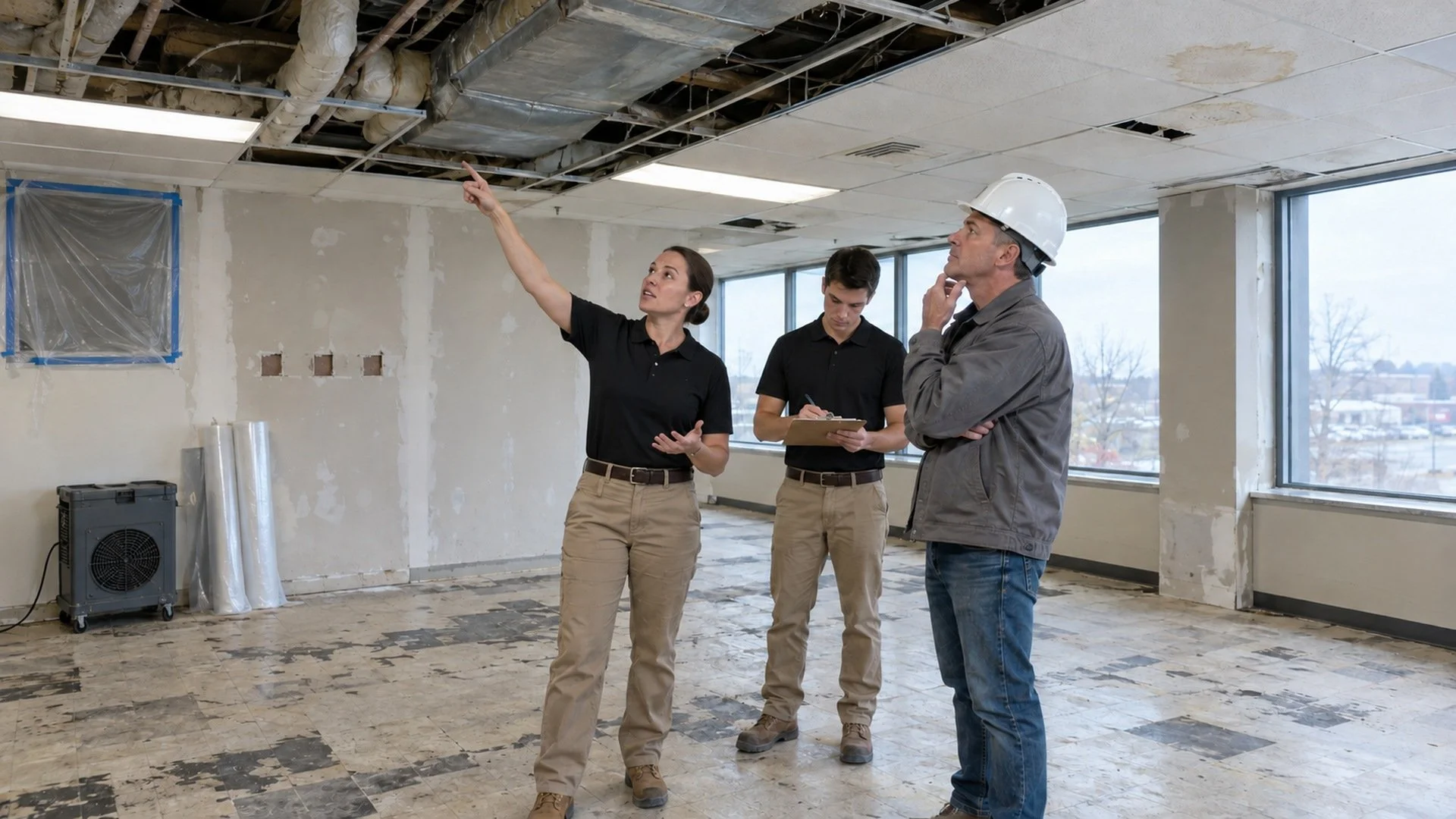
Renovating a commercial building is vastly different from updating a residential home. The sheer scale of the space, the complexity of commercial HVAC and plumbing systems, and the strict web of federal environmental regulations mean that general contractors cannot simply swing a sledgehammer on day one. For property managers, investors, and contractors in Michigan, the most critical phase of a commercial remodel happens before the demolition ever begins. If you fail to properly assess and prepare a building for environmental hazards, your project is guaranteed to face immediate shut-downs, crushing regulatory fines, and massive liability for exposing workers and tenants to toxic materials.
Whether you are converting an old warehouse into modern loft apartments, updating a retail center, or gutting a flooded office floor, the presence of legacy building materials dictates how the project must be managed. Commercial buildings constructed under earlier building practices often harbor vast quantities of asbestos, lead paint, and hidden mold. Navigating these hazards requires strict adherence to EPA, OSHA, and EGLE regulations, beginning with a comprehensive site assessment and ending with highly controlled, professional abatement. Here is what property owners must know to safely prepare their commercial sites for renovation.
The Mandatory Pre-Renovation Asbestos Survey
In the commercial sector, asbestos compliance is not optional; it is a federal mandate. Under the EPA’s National Emission Standards for Hazardous Air Pollutants (NESHAP), property owners or operators must conduct a thorough asbestos inspection before any commercial demolition or renovation begins.
The most dangerous assumption a commercial investor can make is that their "newer" building is exempt from these rules.
Explicitly state that best practice is to assume suspect building materials may contain asbestos regardless of construction date, especially:
Drywall and joint compound
Flooring and mastics
Ceiling tiles and textures
Imported products and components (e.g., materials manufactured in countries without stringent asbestos controls)
Add clear language to your project planning documents that imported or foreign‑manufactured building materials can still contain asbestos today, so the safest approach is to test rather than rely on age alone.
“Regardless of the year your property was built, the safest approach is to treat suspect materials as potentially asbestos‑containing until testing proves otherwise.”
“Because some imported products may still contain asbestos, age alone is not a reliable way to rule out asbestos.”
Before the first wall is opened, an accredited inspector must take physical samples of all suspect materials. If you are wondering what does asbestos look like in a commercial setting, the answer is that it is entirely invisible to the naked eye. Only laboratory testing can confirm its presence.
If the survey identifies regulated asbestos-containing material, the property owner must submit a formal notification to the Michigan Department of Environment, Great Lakes, and Energy (EGLE) at least 10 working days before demolition starts. To comply with these strict asbestos demolition requirements, you must hire a licensed contractor for the asbestos removal Michigan requires. Utilizing specialized engineering controls, the abatement team will perform the asbestos removal process under heavy containment, preventing severe asbestos health risks and keeping the rest of your building safe for the incoming general contractors.
OSHA Lead Regulations for Commercial Construction
If your commercial renovation involves older structures, particularly those with vintage architectural trim, steel girders, or multiple layers of historic paint, you must prepare for lead. While the EPA's Lead RRP rule focuses heavily on residential and child-occupied facilities, commercial renovations are tightly governed by OSHA’s Lead in Construction Standard (29 CFR 1926.62).
This OSHA standard applies to all construction work—including demolition, alteration, and repair—where employees may be exposed to lead. Before renovation begins, the person in charge of the work must ensure that all unknown coatings are evaluated for lead.
If lead is present, OSHA requires employers to conduct an initial exposure assessment. If the demolition activities (like dry-scraping peeling lead paint danger or torch-cutting painted steel) will expose workers to airborne lead above the Action Level of 30 micrograms per cubic meter of air (30 µg/m³), the contractor must implement a written compliance program.
This requires strict lead-safe work practices:
Providing workers with proper respiratory protection (such as N95 or full-facepiece respirators) and protective clothing.
Establishing hygiene facilities, such as hand-washing stations and mandatory showers before leaving the worksite, to prevent lead dust from being tracked home.
Using engineering controls, like HEPA-filtered vacuums and wet methods, to keep the dust below the Permissible Exposure Limit (PEL) of 50 µg/m³.
For commercial property owners, requiring your general contractor to provide proof of their OSHA lead compliance plan, or hiring a specialized team for lead paint abatement Warren MI, is the only way to avoid catastrophic liability and severe lead paint exposure symptoms among the crew.
Preparing for Commercial Mold Remediation
Commercial buildings are highly susceptible to hidden moisture issues. Flat roofs, massive HVAC systems, and complex plumbing chases frequently develop slow leaks that go unnoticed for months. When a renovation crew tears into a drop ceiling or pulls down drywall, they often uncover severe water damage mold risk.
If your initial site assessment reveals a persistent mold smell in house or office spaces, or if you are dealing with basement mold after water damage, you cannot simply instruct the demolition crew to rip it out. Tearing into a large fungal colony without containment will pull millions of spores into the building's commercial HVAC system, instantly contaminating every other suite in the building.
Preparing for mold in commercial buildings requires professional intervention based on the IICRC S520 mold remediation standard. If the contamination is significant, you need environmental remediation services to execute the mold remediation process before general demolition continues.
This preparation includes:
HVAC Isolation: The HVAC system must be shut down and all supply/return vents in the work area sealed with plastic to prevent cross-contamination.
Heavy Containment: The work zone must be isolated using heavy plastic sheeting, often reinforced with temporary stud walls in large commercial spaces.
Pressure Differentials: Commercial-grade negative air machines with HEPA filters must be installed to pull clean air into the containment zone and exhaust filtered air outside.
For property managers dealing with mold remediation for landlords, utilizing professional mold removal near me ensures the biological hazard is eliminated cleanly. Furthermore, coordinating a comprehensive mold inspection alongside your asbestos and lead testing guarantees that your project addresses all indoor air quality hazards simultaneously.
Finalizing Environmental Compliance
The key to a successful commercial renovation is treating environmental preparation as the first, mandatory phase of construction, rather than an afterthought. Skipping the initial environmental testing for property managers to save a few days on the schedule is a gamble that always ends in financial disaster. When hazardous material removal is integrated into the project plan from the beginning, delays are minimized, budgets remain predictable, and liability is mitigated.
If you are preparing to gut a commercial building, update a multifamily property, or renovate a historic office space, contact BDS Environmental before you mobilize your demolition crew. Our expert environmental services Michigan team can provide the accredited asbestos testing, thorough mold and lead inspections, and the licensed asbestos abatement and lead paint removal Michigan requires to keep your commercial project legal, safe, and on track.