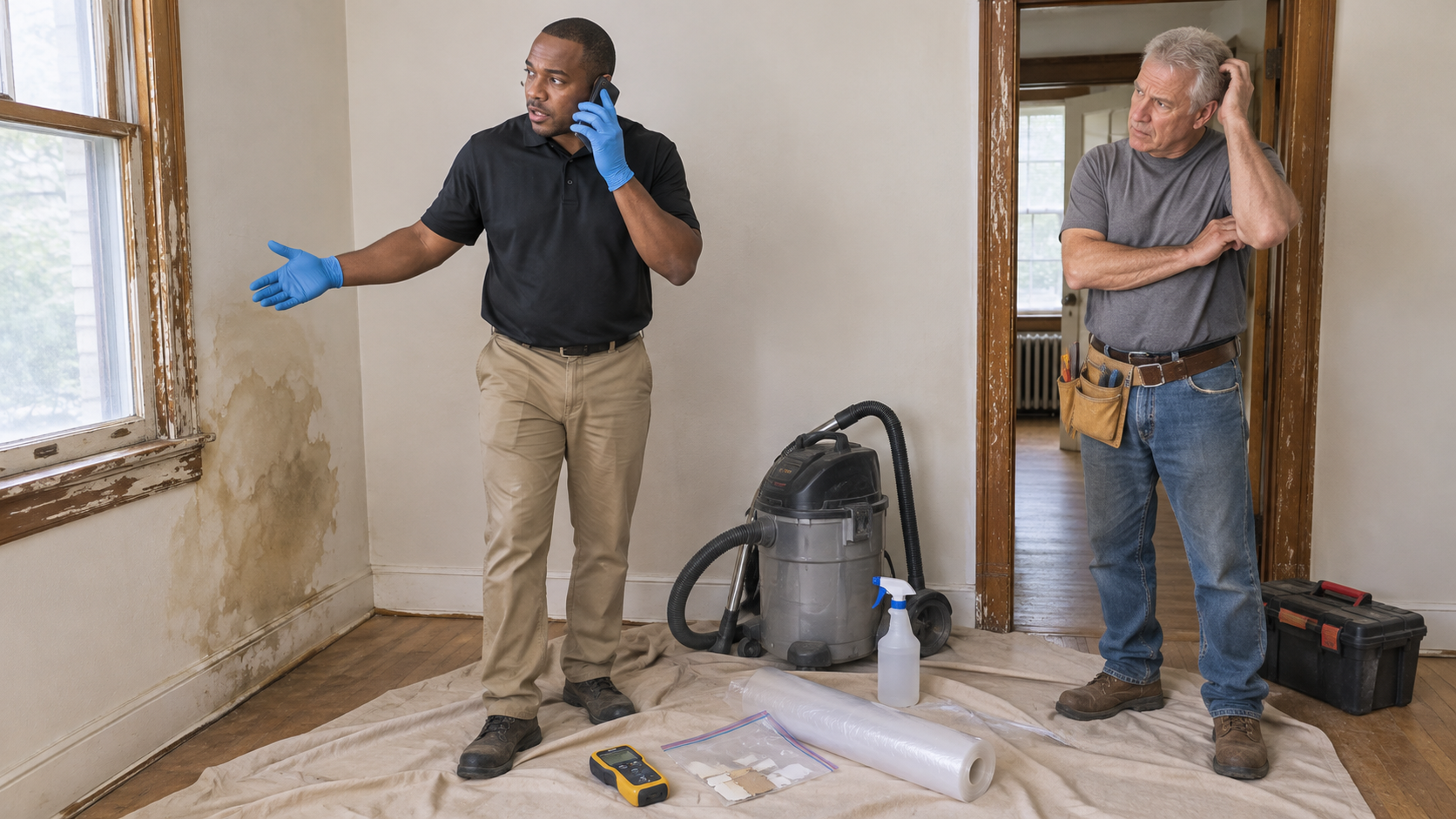
Property management is an exercise in balancing budgets against maintenance needs. To keep properties profitable, landlords rely heavily on a trusted network of general handymen and in-house maintenance staff. These generalists are the lifeblood of real estate operations, expertly handling everything from patching drywall and fixing leaky faucets to hanging new doors and painting between tenants. However, there is a distinct and dangerous boundary between general maintenance and environmental remediation.
When a seemingly routine repair involves water damage, peeling paint, or the demolition of older building materials, dispatching a standard handyman is a massive liability. The regulations governing hazardous building materials are unforgiving, and the health consequences for tenants and workers are severe. Knowing exactly when a work order crosses the line from a simple fix to a regulated environmental project is critical for landlords. Understanding this threshold ensures environmental compliance, protects the property owner from catastrophic fines, and guarantees the safety of the residents.
The 10 Square Foot Mold Rule
Water damage is one of the most common maintenance requests in property management. A roof leak, a slowly dripping sink, or a backed-up washing machine will quickly saturate drywall and subfloors. If a handyman is dispatched immediately to extract the water and fix the leak, the issue is often resolved cleanly. However, if the moisture goes unnoticed for 48 hours, a water damage mold risk becomes a reality.
If the maintenance staff discovers a mold smell in house or finds visible fungal growth on the drywall, landlords must pause. The Environmental Protection Agency provides a clear benchmark: if the mold covers an area smaller than 10 square feet (roughly a 3-by-3-foot patch), a handyman or homeowner can typically clean it up.
However, if the contamination exceeds 10 square feet, is located inside the HVAC ductwork, or keeps returning after being cleaned, professional mold remediation for landlords is strongly recommended. General handymen lack the specialized equipment required for a safe cleanup. A licensed environmental contractor will utilize heavy plastic containment, negative air pressure machines, and HEPA vacuums to prevent microscopic spores from contaminating the rest of the building. Tearing out moldy drywall without these engineering controls exposes the handyman and the tenants to severe mold health risks.
EPA Lead-Safe Certification is Not Optional
In properties built under past standards, repairing a stuck window or replacing a door frame seems like a simple handyman job. But if those components are coated in vintage lead-based paint, the rules change entirely.
The EPA’s Lead Renovation, Repair, and Painting (RRP) Rule is a strict federal mandate that applies directly to landlords and their maintenance staff. If a repair project disturbs more than 6 square feet of interior painted surface per room, or more than 20 square feet of exterior painted surface in a pre-1978 property, the work cannot be performed by an uncertified handyman.
Furthermore, the EPA holds property management companies liable for compliance. If a landlord or their in-house staff performs covered tasks, they must be registered as an "EPA Certified Firm," and at least one worker on the job must be a Certified Renovator who has passed the official 8-hour training course.
Certified environmental contractors are required because the lead paint removal process is highly complex. It forbids open-flame burning, dry scraping, or using power tools without HEPA exhaust controls. The contractor must set up plastic sheeting extending 6 feet in all directions, utilize wet-scraping techniques, and perform specific clearance testing before leaving the job site. Allowing an uncertified handyman to create a peeling lead paint danger during a renovation exposes tenants to lead paint exposure symptoms and exposes the landlord to crippling federal fines.
The Hidden Danger of Asbestos
The most dangerous scenario for a general handyman involves tearing out building materials during a renovation or repair. When upgrading older housing stock, a handyman might pull up old linoleum flooring, knock down an acoustic ceiling, or cut into a pipe chase. Without prior testing, these actions frequently disturb legacy asbestos.
Explicitly state that best practice is to assume suspect building materials may contain asbestos regardless of construction date, especially:
Drywall and joint compound
Flooring and mastics
Ceiling tiles and textures
Imported products and components (e.g., materials manufactured in countries without stringent asbestos controls)
Landlords must not assume that "modern" properties are safe. Add clear language that imported or foreign‑manufactured building materials can still contain asbestos today, so the safest approach is to test rather than rely on age alone. Global supply chains often mean that modern drywall mud or acoustic textures do not adhere to domestic environmental standards.
“Regardless of the year your property was built, the safest approach is to treat suspect materials as potentially asbestos‑containing until testing proves otherwise.”
“Because some imported products may still contain asbestos, age alone is not a reliable way to rule out asbestos.”
If a handyman asks what does asbestos look like, the answer is that it is entirely invisible to the naked eye. Before any destructive maintenance begins, the landlord must order a professional asbestos inspection. If the testing confirms asbestos is present, standard demolition is illegal. The Michigan EGLE program dictates strict asbestos demolition requirements, mandating that the asbestos removal process be performed only by licensed abatement professionals. Tearing out these materials without containment causes severe asbestos health risks. A landlord must transition the project from their handyman to a certified asbestos removal Michigan contractor to ensure the work is done legally.
Overlapping Hazards Require Comprehensive Expertise
Often, a maintenance request involves multiple overlapping hazards. For instance, a handyman dispatched to fix a roof leak in a vintage property might find basement mold after water damage, lead-painted exterior trim that needs replacing, and water-logged drywall joint compound that must be cut out.
An environmental contractor is trained to handle these overlapping threats safely. A professional environmental services Michigan team can simultaneously manage the mold remediation process, navigate the strict lead paint laws Michigan enforces, and execute the licensed hazardous material removal required for the asbestos. A general handyman simply does not have the licensing, the HEPA equipment, or the specialized liability insurance to manage these intertwined indoor air quality hazards.
Protect Your Tenants and Your Liability
Property management requires knowing the limits of your maintenance team. While a reliable handyman is essential for the day-to-day upkeep of a property, dispatching them to handle mold, lead paint, or suspect building materials puts your entire investment at risk. Environmental compliance property owners understand that hiring licensed professionals for hazardous work is not an unnecessary expense; it is a critical liability shield.
If your property has suffered significant water damage, if you are planning a renovation that involves demolition, or if you suspect you are dealing with lead or asbestos before renovation begins, contact BDS Environmental. Our team provides the expert environmental testing for property managers needed to assess the situation accurately. From thorough mold inspection and lead testing to licensed asbestos abatement Warren MI landlords trust, we have the expertise to keep your building compliant, secure, and safe for your tenants.