Maintaining public buildings, schools, and churches is a tremendous responsibility. These structures serve as the cornerstone of our communities, housing vulnerable populations including children, elderly congregation members, and dedicated civil servants. Because many of these historic and mid-century buildings were constructed when durability and fire resistance were paramount, they are heavily laden with legacy environmental hazards. While property managers may be accustomed to dealing with minor maintenance issues, discovering asbestos in a public facility instantly elevates a routine repair to a highly regulated, high-stakes environmental project.
In public buildings—and specifically in educational facilities—environmental safety is heavily scrutinized by both federal and state regulators. A poorly managed renovation or an accidental disturbance of asbestos can lead to devastating asbestos health risks, widespread panic among parents and community members, and crushing legal liabilities. For facility managers and institutional boards, understanding the strict regulatory frameworks governing asbestos, planning for safe hazardous material removal, and prioritizing clear communication are essential for protecting both the occupants and the institution’s reputation.
The Mandate of AHERA in Schools
When it comes to asbestos in homes or commercial spaces, regulations primarily dictate how the material must be removed. However, for K-12 educational facilities, the regulations dictate how the material must be actively managed on a daily basis. In 1986, the federal government enacted the Asbestos Hazard Emergency Response Act (AHERA). This strict law applies to all public school districts and non-profit private schools, including those operated within church facilities.
Under AHERA, school administrators cannot simply wait until a renovation to check for asbestos. They are legally required to:
Perform an Initial Inspection: Use accredited inspectors to identify all asbestos-containing building materials (ACBM) within the facility.
Develop a Management Plan: Create a comprehensive, written plan detailing the location of the asbestos and how it will be managed (e.g., left intact, encapsulated, or removed).
Conduct Ongoing Surveillance: Perform periodic surveillance of the materials every six months and a formal re-inspection by a certified professional every three years.
Provide Annual Notifications: Written notices must be sent to parents, teachers, and employee organizations every year regarding the availability of the management plan and any upcoming abatement activities.
For church administrators who lease space to charter schools or host daily preschools, understanding that your building falls under these strict AHERA guidelines is critical to maintaining your operations legally.
Identifying the Hidden Dangers
If a church board member or a school superintendent asks, "what does asbestos look like?", they must understand that visual identification is impossible. Asbestos was a miracle additive, woven seamlessly into thousands of building products.
Explicitly state that best practice is to assume suspect building materials may contain asbestos regardless of construction date, especially:
Drywall and joint compound
Flooring and mastics
Ceiling tiles and textures
Imported products and components (e.g., materials manufactured in countries without stringent asbestos controls)
Institutions must add clear language to their maintenance protocols that imported or foreign‑manufactured building materials can still contain asbestos today, so the safest approach is to test rather than rely on age alone. Do not let maintenance staff assume a newer wing of a school is entirely safe.
“Regardless of the year your property was built, the safest approach is to treat suspect materials as potentially asbestos‑containing until testing proves otherwise.”
“Because some imported products may still contain asbestos, age alone is not a reliable way to rule out asbestos.”
Before any wall is opened to fix a plumbing leak or a ceiling is dropped to install new IT cables, a targeted asbestos inspection and formal asbestos testing must occur. If the test returns positive, standard maintenance must stop immediately.
Coordinating Safe Asbestos Abatement
When an institution decides to renovate, or when asbestos materials become damaged and friable, the asbestos must be professionally removed. However, executing an asbestos removal process in a public building requires meticulous logistical planning to ensure zero exposure to the occupants.
The Michigan Department of Environment, Great Lakes, and Energy (EGLE) and federal NESHAP standards govern the physical removal process. To comply with these strict asbestos demolition requirements, schools and churches must hire licensed environmental remediation services.
Key safety protocols for public building abatement include:
Strategic Scheduling: Asbestos abatement should never happen while the building is occupied by the public. Projects must be scheduled during summer breaks, winter holidays, or off-hours to eliminate exposure risks.
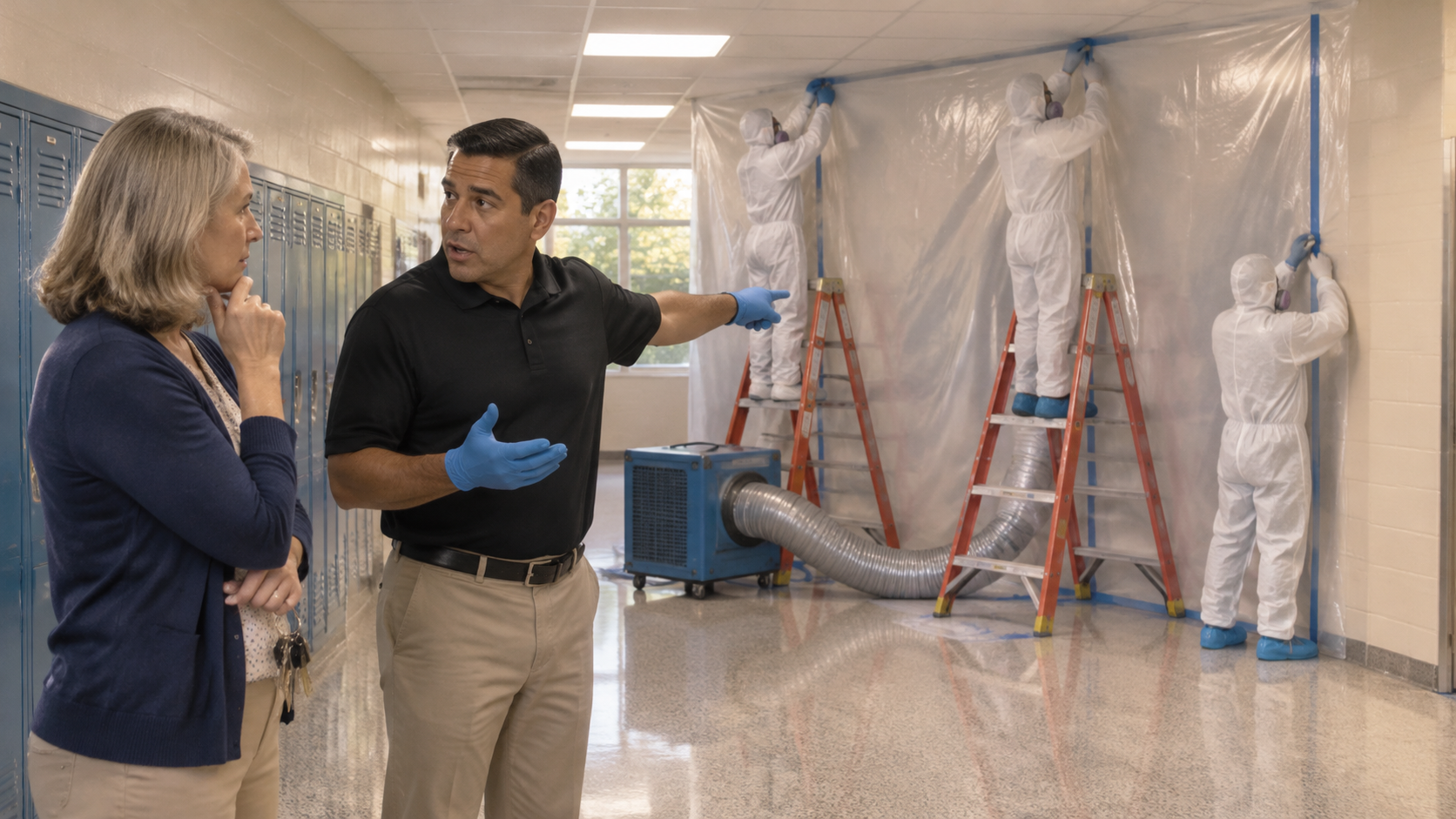
Phased Isolation: If the building must remain partially open, the abatement contractor will work in phases, sealing off specific wings with heavy plastic barriers and negative air pressure machines (HEPA scrubbers) so that clean areas remain completely unaffected.
Clearance Air Monitoring: Once the physical asbestos removal Michigan requires is complete, an independent third-party environmental consultant must perform clearance air testing. The containment barriers cannot be removed, and students or parishioners cannot return until the laboratory proves the air is entirely free of asbestos fibers.
Overlapping Environmental Hazards in Public Buildings
Public buildings are large, complex structures that frequently suffer from deferred maintenance. When planning an asbestos abatement project, facility managers must be prepared to handle overlapping indoor air quality hazards.
For example, a leaking roof above a school gymnasium can saturate ceiling tiles and drywall. This creates a severe water damage mold risk. Within 48 hours, a mold smell in house or gym spaces will develop, leading to black mold symptoms and respiratory issues for students. The institution cannot simply hire a handyman for a quick fix. If the wet drywall contains asbestos, tearing it down will aerosolize carcinogenic fibers.
Resolving this requires an integrated approach. The institution must hire professionals capable of executing safe asbestos removal near me alongside a formal mold remediation process. The contractor will use the same negative air containment to perform both the asbestos abatement and the mold removal near me, safely extracting the moldy, asbestos-laden materials without cross-contaminating the rest of the school.
Similarly, replacing vintage windows in a historic church often disturbs peeling lead paint danger. Toxic lead dust is incredibly harmful to children, causing severe lead paint exposure symptoms and developmental delays. Ensuring your contractor is certified to handle the strict lead paint laws Michigan enforces and can perform a safe lead paint removal process is just as critical as managing the asbestos. Utilizing a single, highly qualified team for lead paint abatement Warren MI, mold remediation Michigan, and asbestos removal ensures the project is completed safely and legally.
Secure Your Community’s Future
Managing a school, church, or public building requires an unwavering commitment to the safety of the community. Attempting to hide environmental hazards or cutting corners during renovations by bypassing licensed hazardous material removal is a violation of public trust and federal law.
If your institution is planning a renovation, dealing with a severe leak, or needs to comply with AHERA regulations regarding asbestos before renovation, contact BDS Environmental. Our specialized environmental services Michigan team provides accurate asbestos testing, detailed mold inspection, and the licensed asbestos removal Warren MI public facilities trust. We handle the environmental safety in older homes and large institutional buildings, ensuring your facility remains a safe, welcoming, and compliant space for the community you serve.