What Happens If Contractors Disturb Asbestos During Renovation?
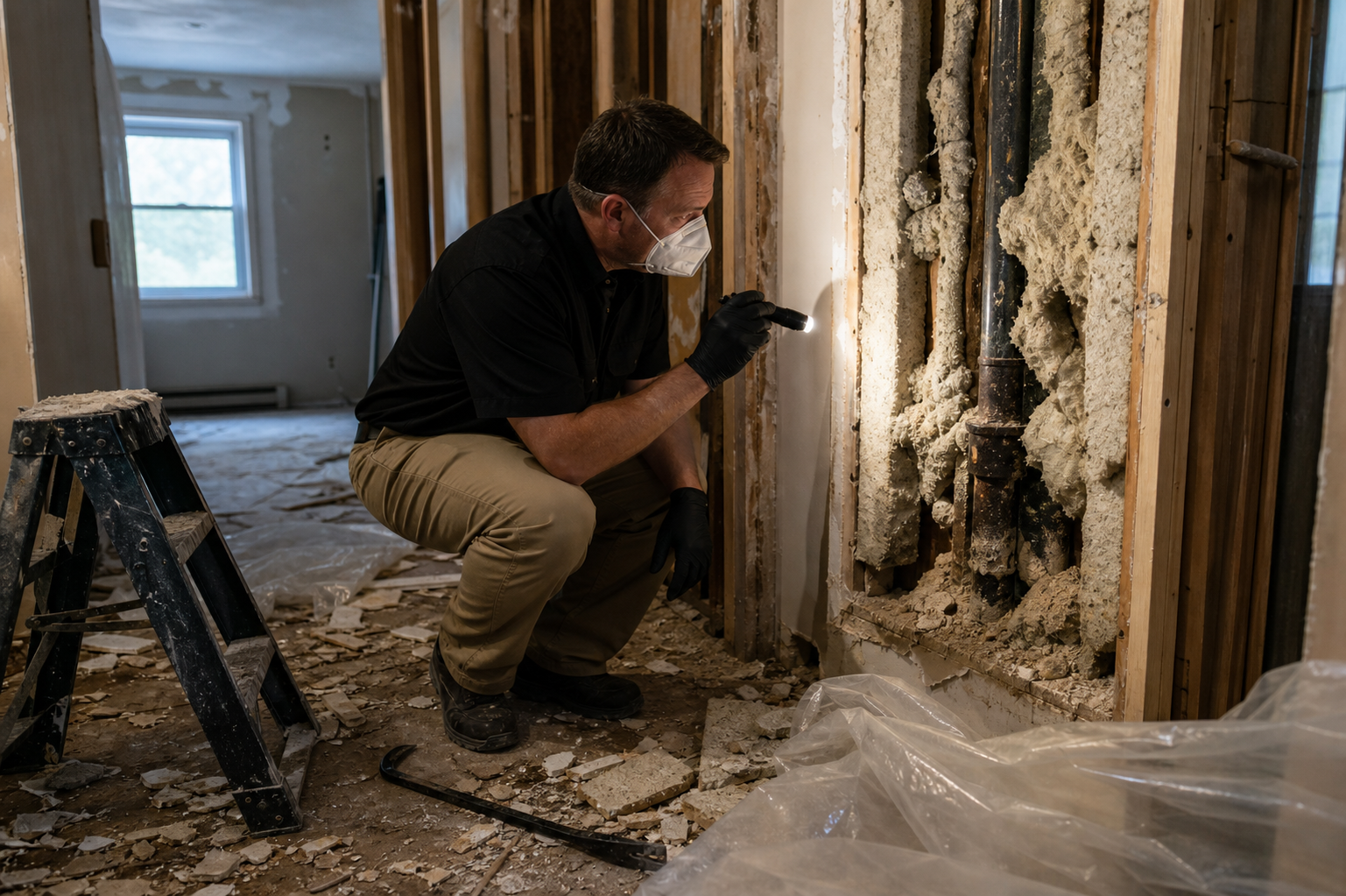
Renovation projects in Michigan move fast. Contractors pull permits, schedule crews, and start demo before many property owners have given much thought to what is inside the walls, under the floors, or above the ceiling tiles. In older homes and commercial buildings, that speed creates a serious problem: asbestos-containing materials that were stable and undisturbed for decades can be cut, scraped, broken, or sanded in a matter of hours—releasing microscopic fibers into the air with no visible warning that anything dangerous has occurred. By the time someone suspects asbestos was disturbed, workers have been exposed, contamination may have spread through the building's HVAC system, and the regulatory clock is already running.
For homeowners, property managers, contractors, and investors working in Metro Detroit, Warren, and other Michigan communities, understanding what happens when asbestos is disturbed during renovation is not a hypothetical exercise. It is the kind of knowledge that prevents an ordinary bathroom remodel or kitchen gut-job from becoming a regulatory enforcement situation, an emergency abatement project, and a significant unplanned cost. Knowing the risks, the regulatory consequences, and the correct response when disturbance occurs is fundamental to managing renovation projects responsibly in Michigan's older building stock.
Why Accidental Disturbance Happens More Often Than Expected
The Materials That Catch Contractors Off Guard
Asbestos-containing materials are not always obvious. They do not look different from non-asbestos versions of the same products, and in many cases the only way to confirm whether a material contains asbestos is laboratory analysis of a collected sample. EPA notes that asbestos was used in hundreds of building products, and that its presence in a given material cannot be determined by visual inspection alone.
https://www.epa.gov/asbestos/learn-about-asbestos
The materials most commonly disturbed without prior testing include:
Drywall joint compound on walls and ceilings, sanded during prep work or demo
Vinyl and asphalt floor tiles and the mastics used to bond them, pulled up or scraped during flooring replacement
Ceiling tiles and sprayed acoustic textures, cut or broken during lighting, HVAC, or ceiling work
Pipe and boiler insulation disturbed during mechanical system repairs or upgrades
Roofing materials and built-up roofing components during tear-off projects
Best practice is to assume suspect building materials may contain asbestos regardless of when a property was built. Because some imported or foreign-manufactured building products—including drywall, joint compound, flooring, and ceiling products from countries without stringent asbestos regulations—can still contain asbestos today, construction date alone is not a reliable way to rule it out. Regardless of the year your property was built, the safest approach is to treat suspect materials as potentially asbestos-containing until asbestos inspection and asbestos testing prove otherwise.
What Actually Happens When Asbestos Is Disturbed
Fiber Release and Immediate Exposure Risk
When asbestos-containing materials are cut, broken, sanded, or scraped without proper controls, they release microscopic fibers that become airborne. These fibers are invisible to the naked eye and have no odor—workers and occupants in the area have no sensory indication that exposure is occurring. EPA and NIEHS both note that inhaled asbestos fibers can become permanently lodged in lung tissue, where they are associated with mesothelioma, lung cancer, and asbestosis—diseases with latency periods that can extend decades past the original exposure.
https://www.niehs.nih.gov/health/topics/agents/asbestos
There is no established safe level of asbestos exposure, and the asbestos health risks associated with even relatively brief, high-concentration exposures during uncontrolled disturbance events are taken seriously by both OSHA and EPA.
How Fibers Spread Through a Building
Once asbestos fibers are airborne in an uncontrolled work environment, they can travel far beyond the immediate work zone. Without containment and negative air pressure:
HVAC systems can distribute fibers throughout the building within minutes of disturbance
Workers carry fibers on their clothing into adjacent areas, vehicles, and even their own homes
Fibers settle on horizontal surfaces throughout the building, where they remain a hazard until professional HEPA cleaning is performed
In commercial buildings or multi-unit residential properties, contamination can spread to occupied areas before anyone realizes asbestos was involved
This is why accidental asbestos disturbance in a single room can require emergency remediation affecting an entire floor or building.
Regulatory Consequences for Contractors and Building Owners
EPA NESHAP Requirements and Violations
EPA's National Emission Standards for Hazardous Air Pollutants (NESHAP) for asbestos establish mandatory pre-renovation inspection requirements, work practice standards, notification timelines, and disposal requirements for commercial renovation and demolition projects. Violating NESHAP can result in civil penalties of up to $70,117 per day per violation, and in serious cases, criminal penalties.
https://www.epa.gov/asbestos/asbestos-national-emission-standards-hazardous-air-pollutants-neshap
For demolition projects, pre-demolition asbestos abatement is required regardless of the quantity of asbestos-containing material present. For renovation projects, NESHAP requires a thorough asbestos inspection before work begins that will disturb regulated materials, and written notification to the appropriate regulatory agency at least 10 working days before the project starts.
Contractors who skip pre-renovation asbestos inspections and disturb asbestos-containing materials without proper procedures face significant enforcement exposure. Building owners who fail to provide known asbestos information to contractors—or who hire contractors without verifying compliance—may share in that liability.
OSHA Enforcement and Worker Protection
OSHA's asbestos standard for construction establishes permissible exposure limits and requires air monitoring, respiratory protection, decontamination procedures, worker training, and medical surveillance for workers who may encounter asbestos during renovation or demolition. When asbestos is disturbed without these protections in place, OSHA citations can follow for both the contractor and, in some circumstances, the building owner.
https://www.osha.gov/asbestos
For Michigan property owners and managers, OSHA's requirements apply directly to the contractors you hire to work in your buildings. You have a responsibility to inform contractors about known asbestos conditions, and contractors have an obligation to follow safe work practices when asbestos may be present. When neither party takes that responsibility seriously, workers bear the consequences.
Michigan Licensing and State Oversight
In Michigan, asbestos abatement contractors must be licensed through the state, and MIOSHA enforces asbestos standards in Michigan workplaces. Renovation projects that disturb asbestos-containing materials without the involvement of licensed Michigan asbestos professionals face state-level enforcement in addition to federal EPA and OSHA action. The combination of federal and state regulatory exposure makes unpermitted asbestos disturbance one of the highest-consequence environmental compliance failures a Michigan property owner or contractor can face.
What Must Happen After Accidental Disturbance
Stop Work and Restrict Access Immediately
The first and most important step when asbestos disturbance is suspected is to stop all work in the affected area immediately and restrict access by workers and building occupants. Do not run HVAC systems in the affected zone, as this will continue distributing fibers throughout the building. Seal off the area as much as possible with available materials until a certified asbestos professional can assess the situation.
Every minute of continued activity in a contaminated area without controls increases the extent of fiber spread and the eventual scope of emergency remediation.
Notify the Appropriate Parties
Depending on the nature of the project and the building type, notifications may be required to:
EPA and MDEQ under NESHAP requirements for commercial projects
OSHA if workers have been exposed without appropriate protection
Building occupants or tenants if contamination may have spread to occupied areas
The building owner, if the contractor is the party who made the discovery
Attempting to continue work and conceal an accidental asbestos disturbance is not a viable option. Regulatory agencies take concealment seriously, and the consequences for covering up a known release are significantly more severe than those for promptly reporting and responding to one.
Bring in Certified Asbestos Abatement Professionals
Emergency asbestos abatement after accidental disturbance follows the same fundamental process as planned abatement, but under compressed timelines and often with an expanded scope because fibers have already spread. Certified abatement professionals will:
Establish proper containment with polyethylene sheeting and negative air pressure throughout the affected zone
Run HEPA-filtered air scrubbers continuously to capture airborne fibers
HEPA vacuum all surfaces in the contaminated area, including floors, walls, horizontal surfaces, and HVAC components if contamination entered ductwork
Remove any additional asbestos-containing materials that will be disturbed during the cleanup process
Package and dispose of all waste in sealed, labeled containers transported to a licensed disposal facility
Emergency remediation scopes are almost always larger and more expensive than properly planned pre-renovation asbestos abatement would have been. The cost of doing it right before renovation starts is consistently lower than the cost of emergency response after disturbance.
Clearance Testing Before Reoccupancy
After emergency abatement is complete, clearance air sampling must confirm that fiber concentrations in the remediated area meet regulatory standards before workers return or occupants reoccupy the space. CDC and NIOSH both emphasize that post-remediation verification is an essential part of confirming that cleanup was effective.
https://www.cdc.gov/niosh/mold/testing-remediation/index.html
Clearance testing results must be documented and retained as part of the project record.
How to Prevent Accidental Disturbance
Asbestos Inspection Before Renovation Is the Standard
The entire sequence of events described above—emergency shutdown, regulatory notification, emergency abatement, clearance testing, regulatory enforcement—is preventable with one step: commissioning a professional asbestos inspection before renovation begins.
A certified asbestos inspector samples suspect materials in the project area and submits them for laboratory analysis, producing a written report identifying which materials contain asbestos, where they are located, and what their condition is. That information allows contractors to plan work appropriately, include asbestos abatement in the project scope and budget before demo begins, and proceed with confidence that they are not creating an uncontrolled asbestos release mid-project.
For Michigan property owners and managers, asbestos inspection before renovation is not an extraordinary precaution—it is the baseline standard for responsible project management in any building with original building materials, regardless of construction date.
The Imported Materials Factor
Because some imported or foreign-manufactured building products can still contain asbestos today, even properties that have undergone partial renovation using newer materials cannot be assumed asbestos-free without testing. Drywall, joint compound, ceiling tiles, and flooring products manufactured in countries without strong asbestos regulations have been documented to contain asbestos, and they can appear in any building regardless of when it was built or most recently updated. Because some imported products may still contain asbestos, age is not a reliable guide—test rather than assume.
When Asbestos Intersects with Other Hazards
In many Michigan properties, renovation work that uncovers asbestos may also disturb lead-based paint on adjacent surfaces or encounter mold conditions in the same work area. Lead-safe work practices must be incorporated into any renovation that disturbs surfaces where lead-based paint may be present, and mold remediation work that involves demolishing building materials must account for the potential presence of asbestos in those materials.
Coordinating environmental remediation services—asbestos abatement, lead paint removal, and mold remediation—under an integrated project scope is the most efficient approach when these hazards overlap, as they frequently do in older Michigan homes and commercial properties.
The Cost of Skipping Asbestos Inspection Is Always Higher Than the Alternative
Accidental asbestos disturbance during renovation is a preventable problem. The regulatory consequences, emergency remediation costs, worker exposure liability, and project delays that follow an uncontrolled asbestos release consistently cost more than a professional asbestos inspection and planned abatement would have. For Michigan property owners, investors, and contractors, treating asbestos inspection as a standard pre-renovation step is not bureaucratic caution—it is sound project management.
If you are planning renovation or demolition work on a Michigan property and have not yet had suspect building materials tested, or if you believe asbestos may have already been disturbed during recent work, BDS Environmental can help. The team works with homeowners, property managers, contractors, and investors throughout Michigan to conduct thorough asbestos inspections, respond to accidental disturbance situations, design and execute abatement scopes, and deliver the documentation that supports regulatory compliance and project continuity. If asbestos is a concern for your upcoming project, contact BDS Environmental before work begins—not after.